 japan
japan canada
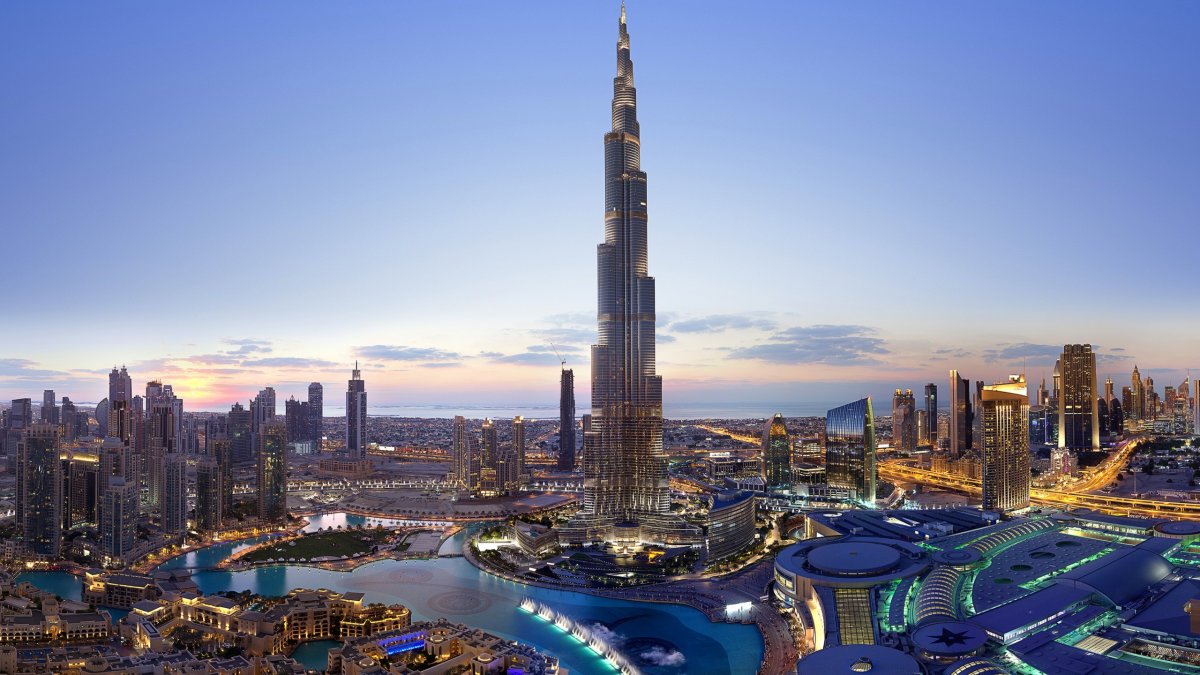
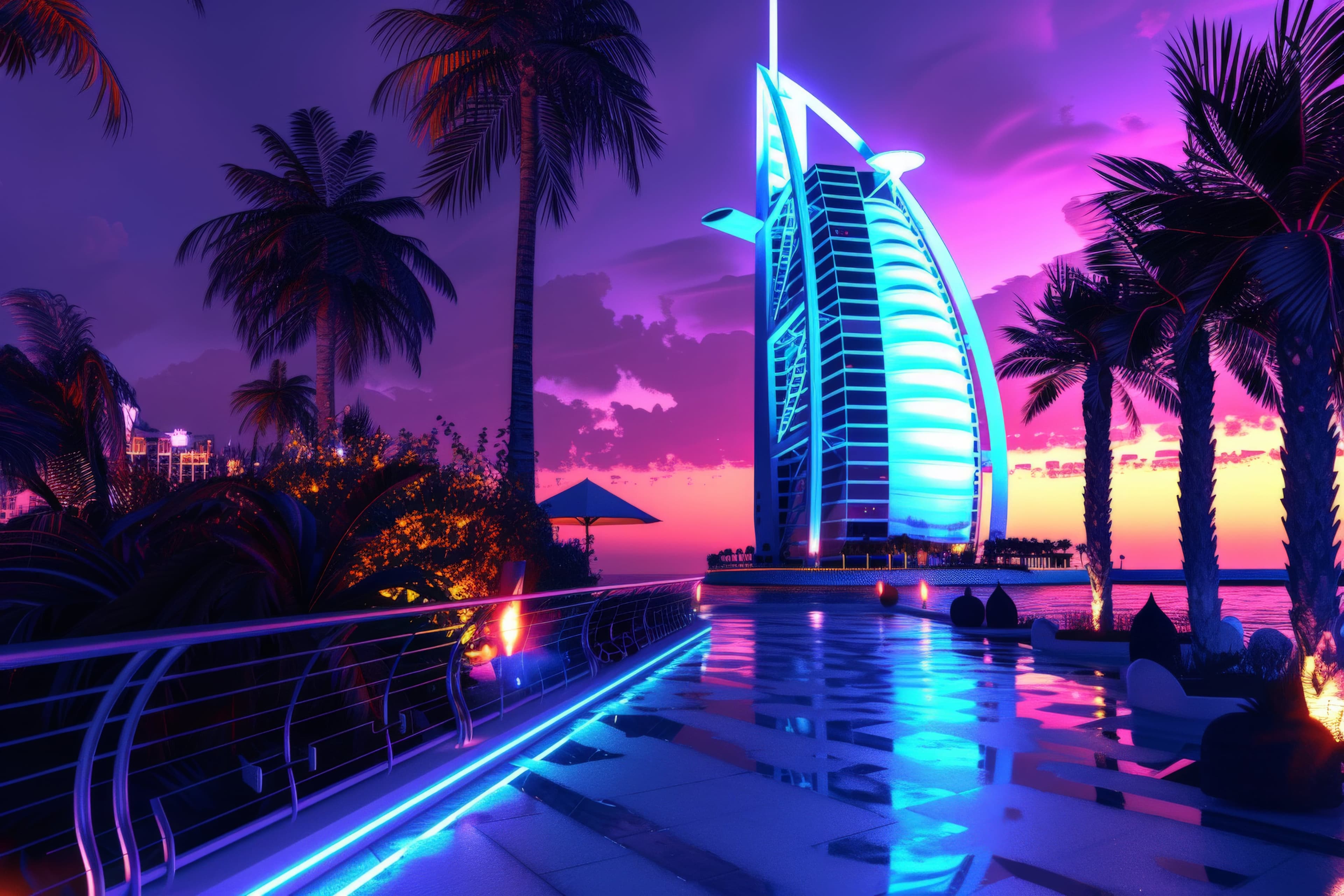 Dubai
Dubai london
 Singapore
Got questions? We've got answers. Explore everything you need to know in one place.
Dubai's vision to diversify its economy from oil to tourism led to its construction. It was built by Emaar Properties and designed by Skyscraper, Owings & Merrill.
Emaar Properties.
Approximately 6 years (2004–2010).
Adrian Smith of Skyscraper, Owings & Merrill (SOM).
Bill Baker.
Approximately $1.5 billion USD.
We'd love to hear from you
Loading comments…
The Burj Khalifa history and construction story began in the early 2000s, during a period when Dubai's skyline was changing rapidly. In January 2004, developer Emaar Properties started the construction. At that time, the tower was known as "Burj Dubai." After nearly six years of work, it officially opened on January 4, 2010. The tower was renamed "Burj Khalifa" to honor Sheikh Khalifa bin Zayed Al Nahyan, the then-president of the UAE.
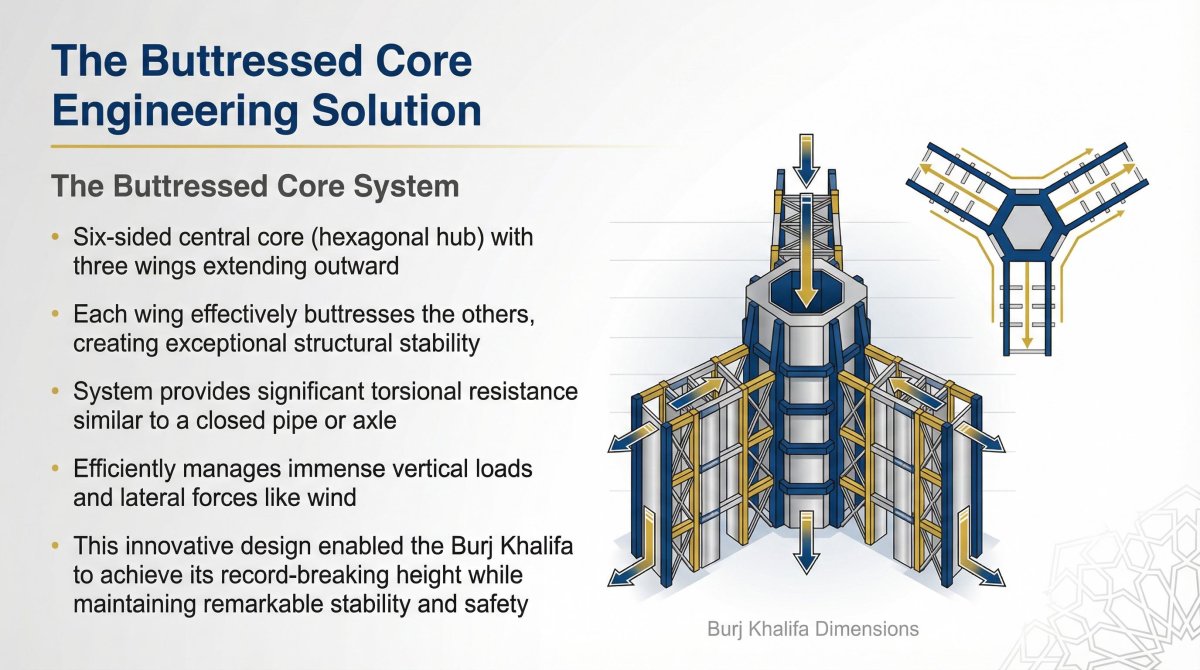
The Burj Khalifa stands 828 meters (2,716.5 feet) tall, making it the world's tallest building. It was built at a reported cost of about $1.5 billion. Architect Adrian Smith and structural engineer Bill Baker, both from Skidmore, Owings & Merrill (SOM), designed the tower. They created a Y-shaped plan with three wings extending from a central core. This design became the basis of the tower's buttressed-core structural system. It helps the building withstand strong wind forces at such an extraordinary height.
|
Feature |
Details |
|
Height |
828 meters (2,716.5 feet) |
|
Total Floors |
163 floors above ground (plus basement and mechanical floors) |
|
Opening Date |
January 4, 2010 |
|
Construction Cost |
About $1.5 billion USD |
|
Developer / Owner |
Emaar Properties PJSC |
|
Main Architect |
Adrian Smith (Skidmore, Owings & Merrill) |
|
Chief Engineer |
William F. Baker (Skidmore, Owings & Merrill) |
|
Main Contractors |
Samsung C&T, BESIX, Arabtec Construction |
|
Location |
Downtown Dubai, United Arab Emirates |
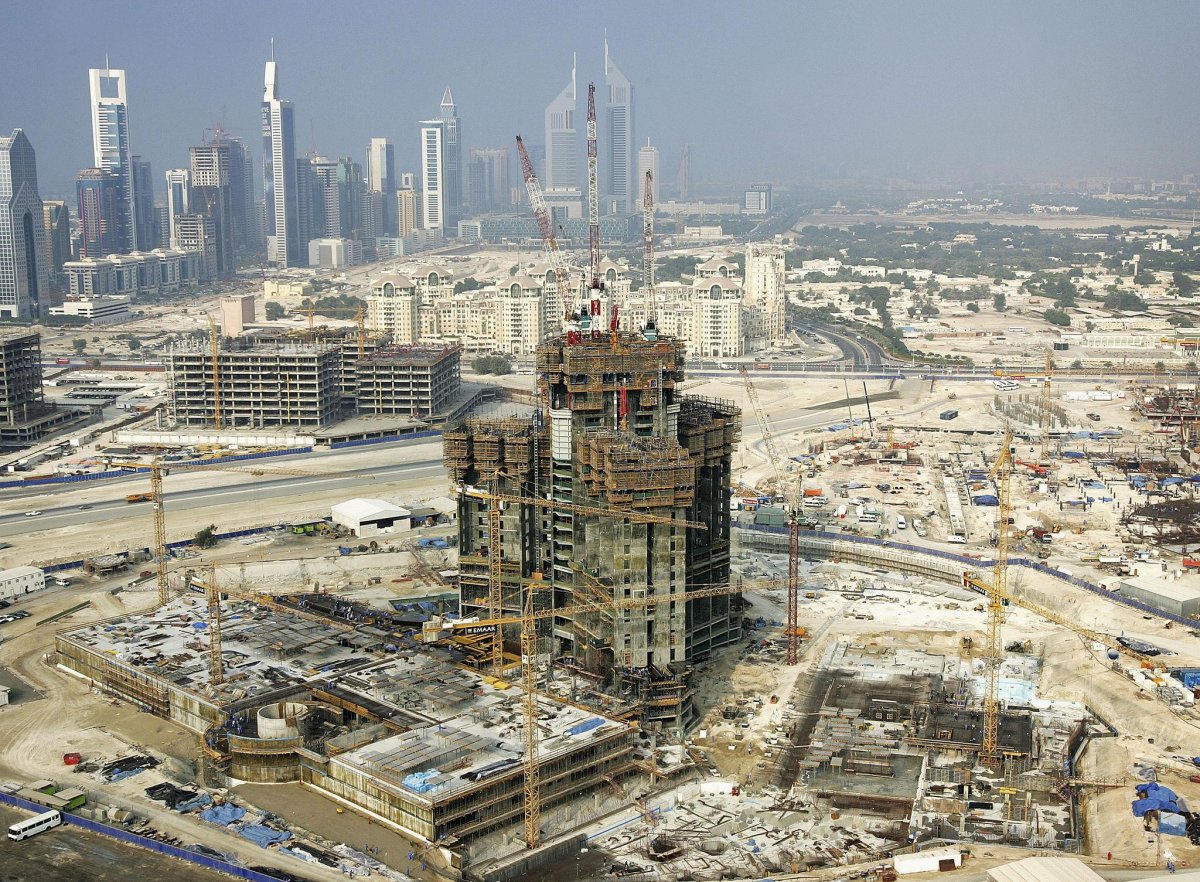
In the late 1990s, Dubai's leaders knew one big problem: oil would not last forever. They needed a new way to grow the economy. His Highness Sheikh Mohammed bin Rashid Al Maktoum had a vision. He wanted Dubai to become a global hub for business, trade, and luxury tourism. But for that, the city needed a landmark that would catch the world's attention.
This vision led to the Downtown Dubai master plan. It was a massive 500-acre project. The plan included luxury homes, commercial offices, high-end hotels, and the world's largest shopping mall, The Dubai Mall. But the main attraction was a record-breaking supertall skyscraper at the center of it all.
Emaar Properties took charge of this mega-project. The company's founder and chairman, Mohamed Alabbar, led the team. At first, the building was named "Burj Dubai" (Dubai Tower). The idea was simple: build a "vertical city" inside one tower. This meant people could live, eat, work, and stay in luxury, all without leaving the building.
For six years, everyone called the project "Burj Dubai." But in 2008 and 2009, the global financial crisis hit hard. Property markets around the world crashed, and Dubai suddenly faced serious money problems.
That is when Sheikh Khalifa bin Zayed Al Nahyan stepped in. He was the Ruler of Abu Dhabi and the President of the UAE. He gave Dubai a massive $10 billion support package to help pay its debts.
To thank him for this help, Sheikh Mohammed bin Rashid Al Maktoum made a surprise announcement. On January 4, 2010, at the official opening ceremony, he announced the tower's new name: "Burj Khalifa."
The design of the Burj Khalifa mixes culture with nature. Here is how:
The Desert Spider Lily: The building's shape comes from a local desert flower called the Hymenocallis. This flower has three petals that branch out from the center. The tower's three wings follow the same pattern.
Islamic Architecture: The tower's stepped design, which spirals upward, is inspired by traditional Islamic geometric patterns. You can see similar shapes in old minarets.
Aerodynamic Efficiency: The tower's tiered shape breaks up strong high-altitude winds. This stops the wind from building up and shaking the building.
Most very tall buildings use thick columns on the outside or a strong center to stand up. But above 500 meters, the wind pushes them so hard that they start to sway dangerously.
To solve this problem, structural engineer Bill Baker created a new design called the "buttressed core." Here is how it works:
Hexagonal Central Core: A strong six-sided center acts like the building's spine. It keeps the tower from twisting in the wind.
Three Extended Wings: Each wing has its own thick concrete walls. These walls support the center from three different directions, making the tower very stable.
Stepped Setbacks: As the tower goes up, the wings step back in 26 different levels. This breaks up the wind so it cannot push the building all in one go.
Above 600 meters, strong winds can create dangerous air swirls. Engineers call this "vortex shedding." These swirls can make a tall building shake violently.
Instead of fighting the wind head-on, the Burj Khalifa uses its stepped Y-shape to handle it. As the wind hits the tower, the stepped design breaks the air into small, random swirls at different levels. This confuses the wind and stops the building from swaying.
|
Date |
Construction Milestone |
|
January 2004 |
Digging and drilling work starts at the site |
|
February 2005 |
Foundation work finishes; the main concrete structure starts going up |
|
July 2007 |
The tower becomes the world's tallest building, beating Taipei 101 (508 m) |
|
March 2008 |
It becomes the tallest man-made structure, beating the KVLY-TV mast |
|
January 17, 2009 |
The tower reaches its maximum height of 828 meters |
|
September 2009 |
The outside glass facade is fully installed |
|
January 4, 2010 |
The Burj Khalifa officially opens to the public |
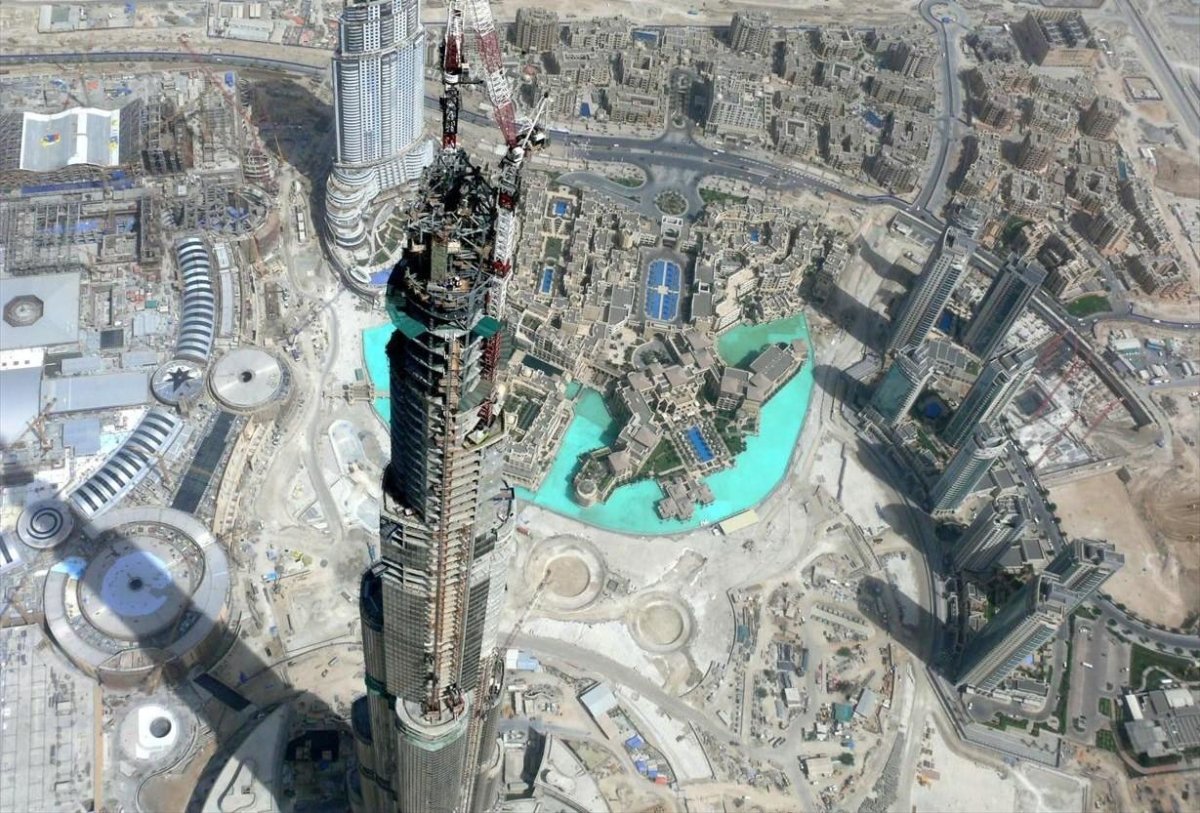
Dubai's ground is not strong. It is mostly made of loose sand and soft, porous rock. There is no hard rock near the surface to hold such a huge building. So, engineers had to build a very deep and strong foundation. Here is what they did:
A Thick Concrete Base: Workers dug a deep pit and poured a thick concrete base (called a "raft") on the ground. This base is 3.7 meters (12.1 feet) thick and used 12,500 cubic meters of strong concrete.
192 Deep Piles: Under this base, they drilled 192 concrete pillars (called "piles") deep into the ground. Each pile is 1.5 meters wide and goes more than 50 meters (164 feet) deep.
Protection from Salt Water: The ground water in Dubai is salty, which can rust steel. To stop this, engineers used special concrete that water cannot pass through. They also installed a system that sends a small electric current through the foundation to block corrosion.
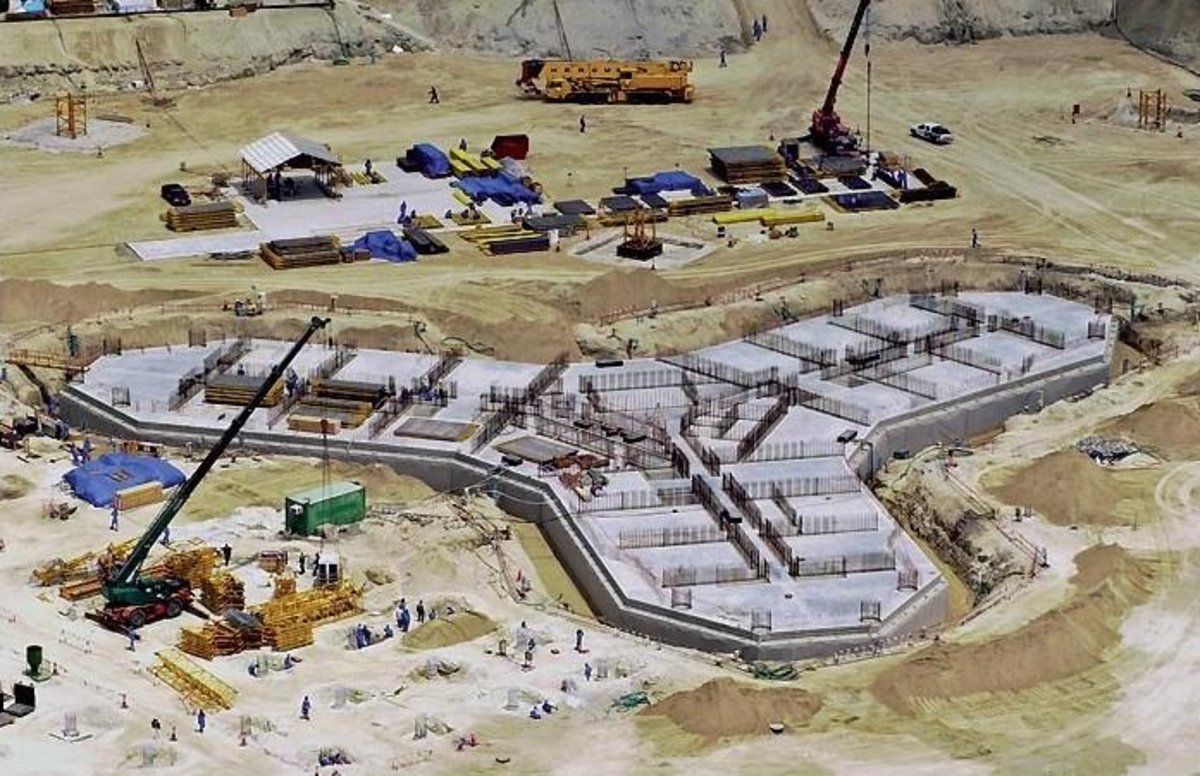
Dubai's summer is very hot. Temperatures can go above 45°C (113°F). In such heat, concrete dries too fast. This causes cracks inside and makes the building weaker. To solve this problem, engineers did two things:
Pouring at Night with Ice: They poured concrete mostly at night when it was cooler. They also mixed crushed ice into the concrete to keep it from drying too fast.
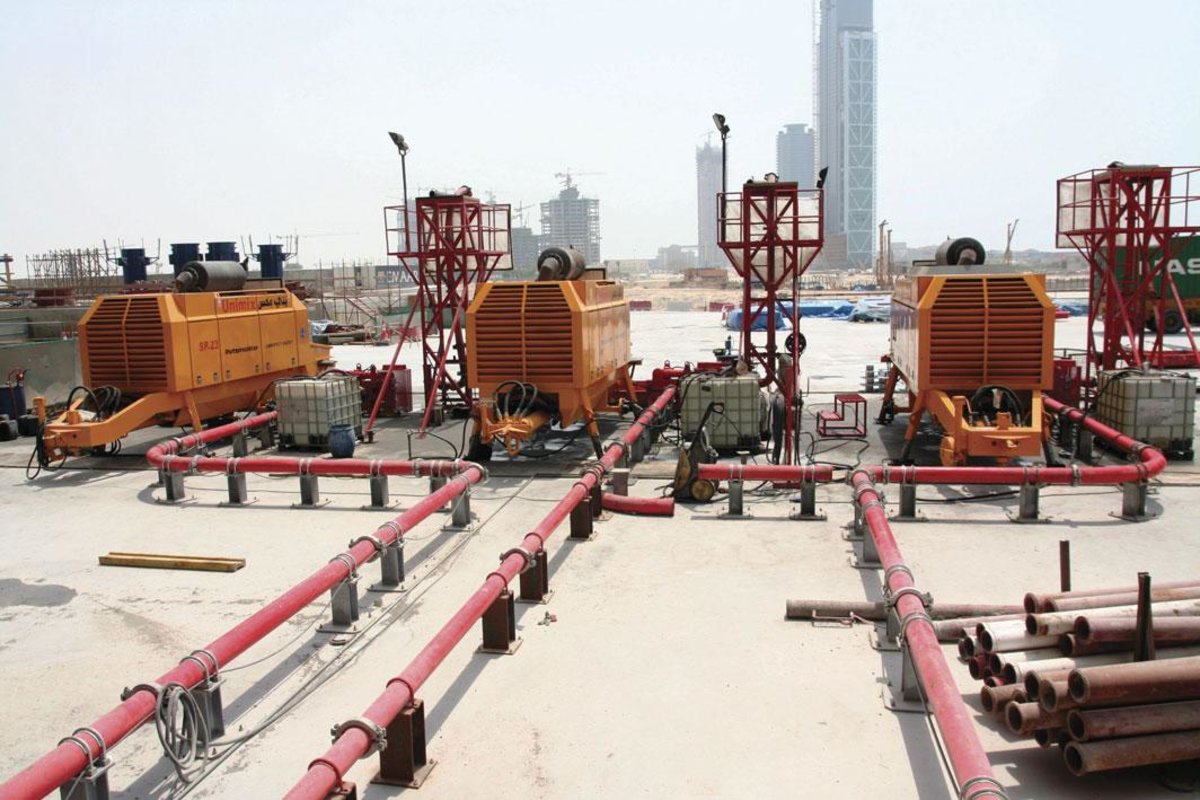
Pumping Concrete to Record Heights: They needed to push concrete up more than 600 meters. For this, they used powerful pumps made by a company called Putzmeister. These pumps pushed the concrete through strong steel pipes at very high pressure (over 200 bar). It was a world record at that time.
The outside of the Burj Khalifa is covered with a special "curtain wall." This is not a curtain like in your home. It is a skin of glass and metal that covers the whole building. Here is what it includes:
Over 26,000 Glass Panels: The building's outside has more than 132,000 square meters of surface. This is covered with over 26,000 individual glass panels.
Three Layers of Protection: The curtain wall uses three main materials: high-performance reflective glass, embossed stainless steel panels, and extruded aluminum frames.
How It Keeps the Building Cool: The outer glass reflects the sun's heat away. The inner layer has a special ceramic coating that insulates the building. This means the air conditioning does not have to work as hard, which saves a lot of energy.
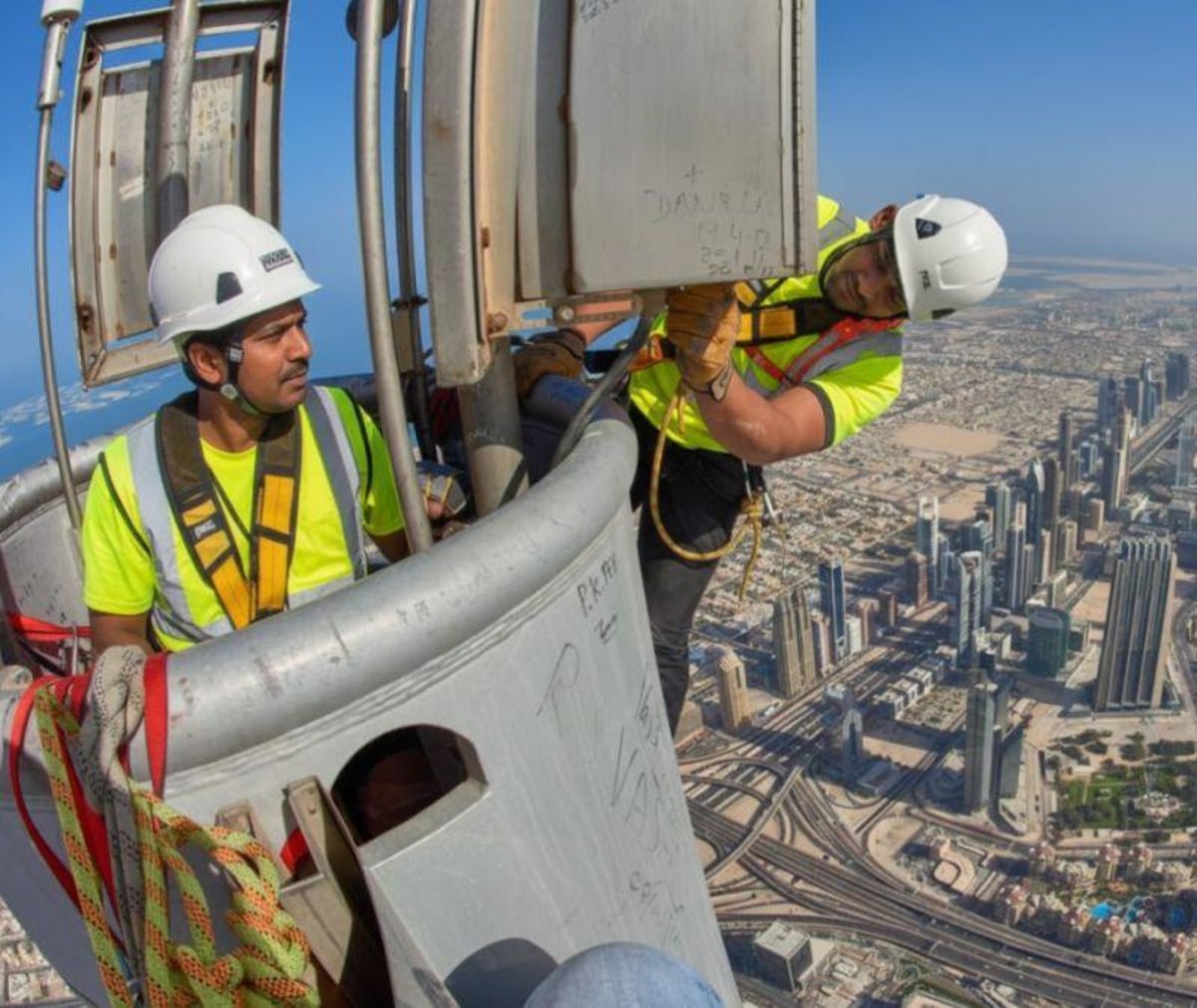
The top part of the Burj Khalifa is called the "spire." It is a long, pointed structure that sits at the very top of the tower. This spire weighs 4,000 tons (about the same as 600 adult elephants). Building it was one of the hardest parts of the project. Here is how engineers did it:
The Problem: Above 750 meters, the wind was too strong. Tower cranes could not work safely at that height.
The Solution: Engineers built the spire in smaller pieces inside the top of the building. They used powerful machines called "hydraulic strand jacks" to slowly push the spire upward through the top of the tower.
The Result: Over several months, the spire was locked into its final position. This gave the Burj Khalifa its final height of 828 meters.
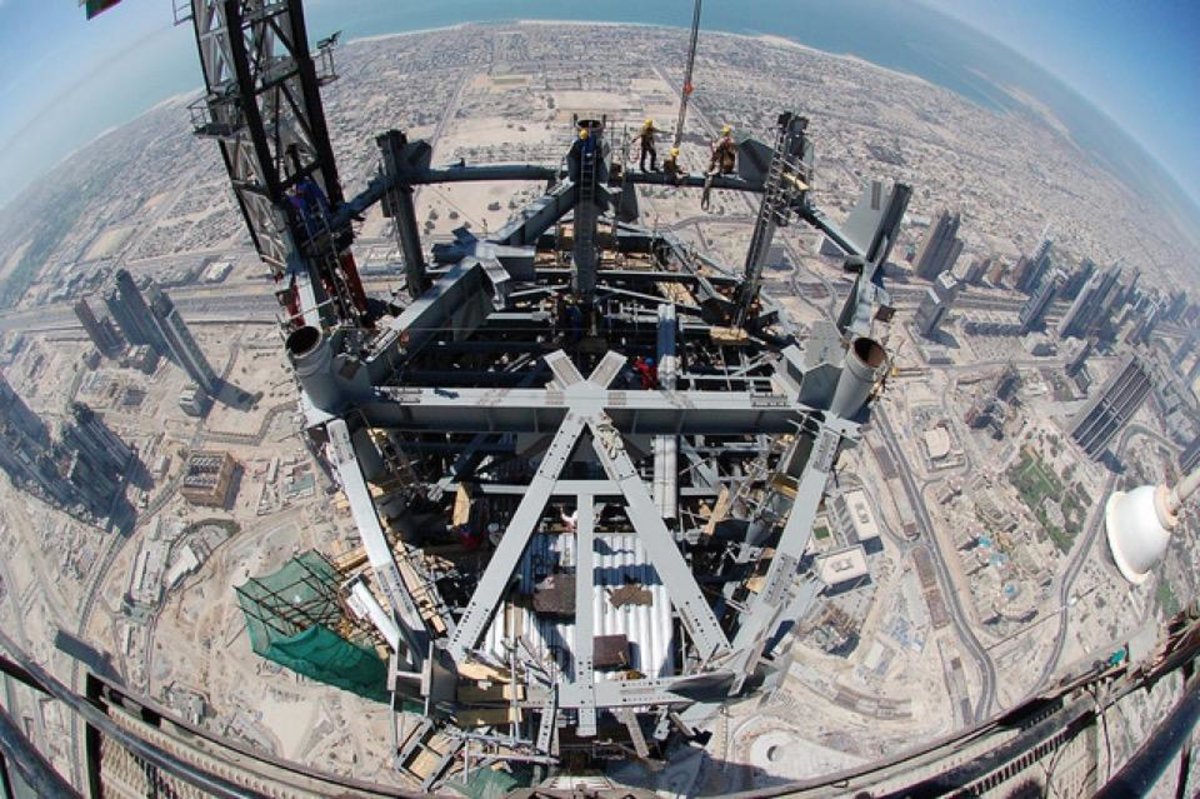
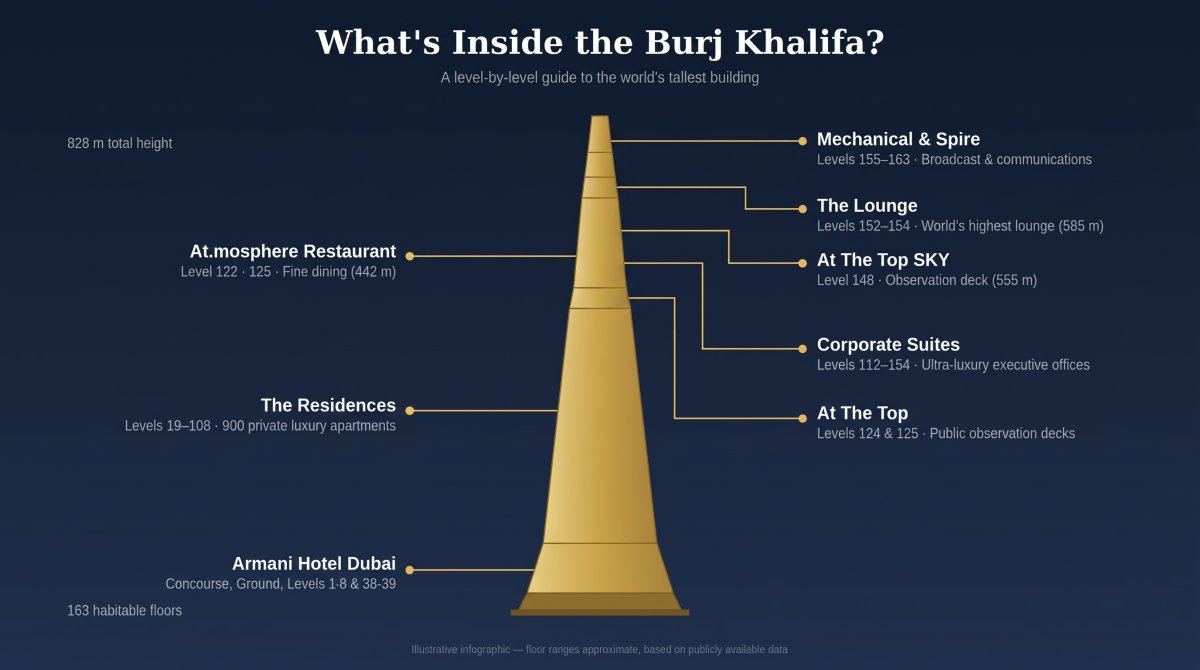
The Burj Khalifa is not just a tall tower. It is a whole city inside one building. It has homes, offices, a hotel, restaurants, and observation decks. Here is what you will find inside, from bottom to top.
This is the world's first hotel designed by the famous fashion designer Giorgio Armani. It has 160 luxury guest rooms and 144 private residences. Everything inside, from the furniture to the lighting, was chosen by Armani himself.
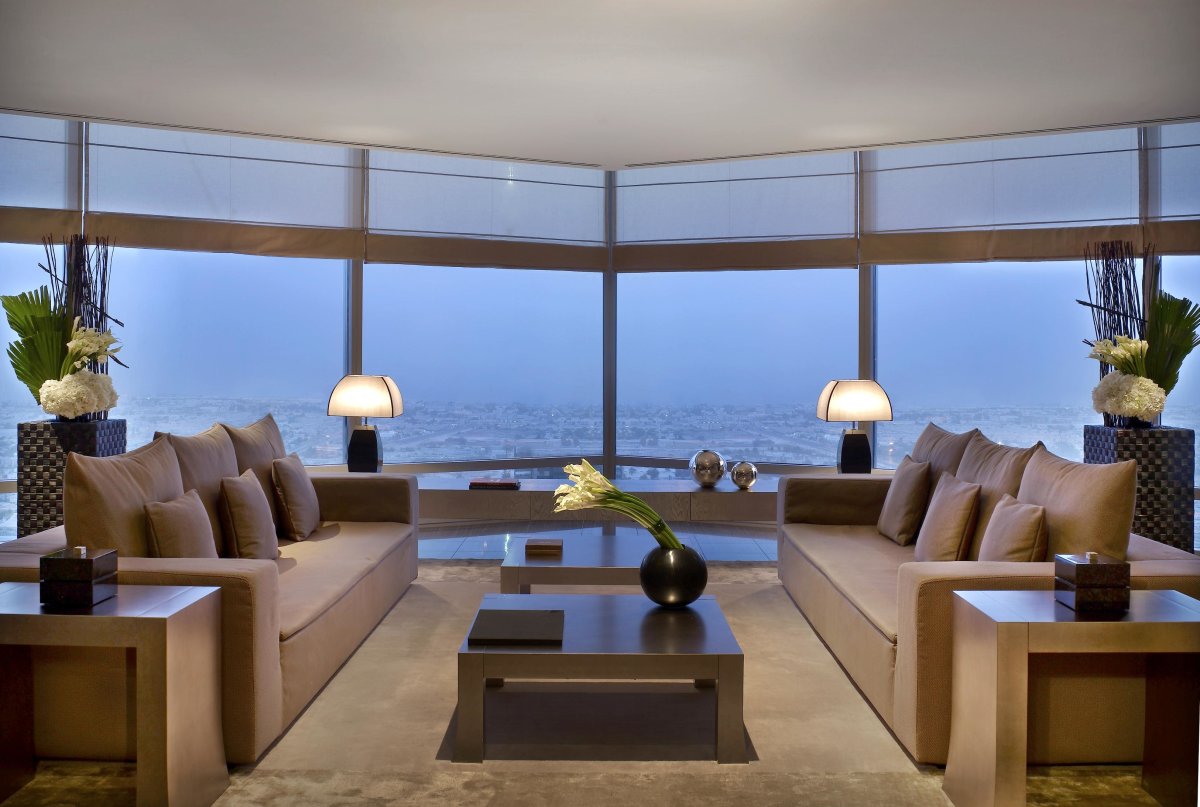
There are about 900 private apartments in the tower. They range from small studios to large four-bedroom homes. People who live here get special perks like private sky lobbies, indoor and outdoor swimming pools, and fitness clubs on Levels 43 and 76.
These are office spaces for big companies and investors. They are located very high up in the tower, offering amazing views of Dubai while you work.
This restaurant sits 442 meters above the ground. It is one of the highest fine-dining restaurants in the world. You can enjoy a meal while looking down at the entire city.
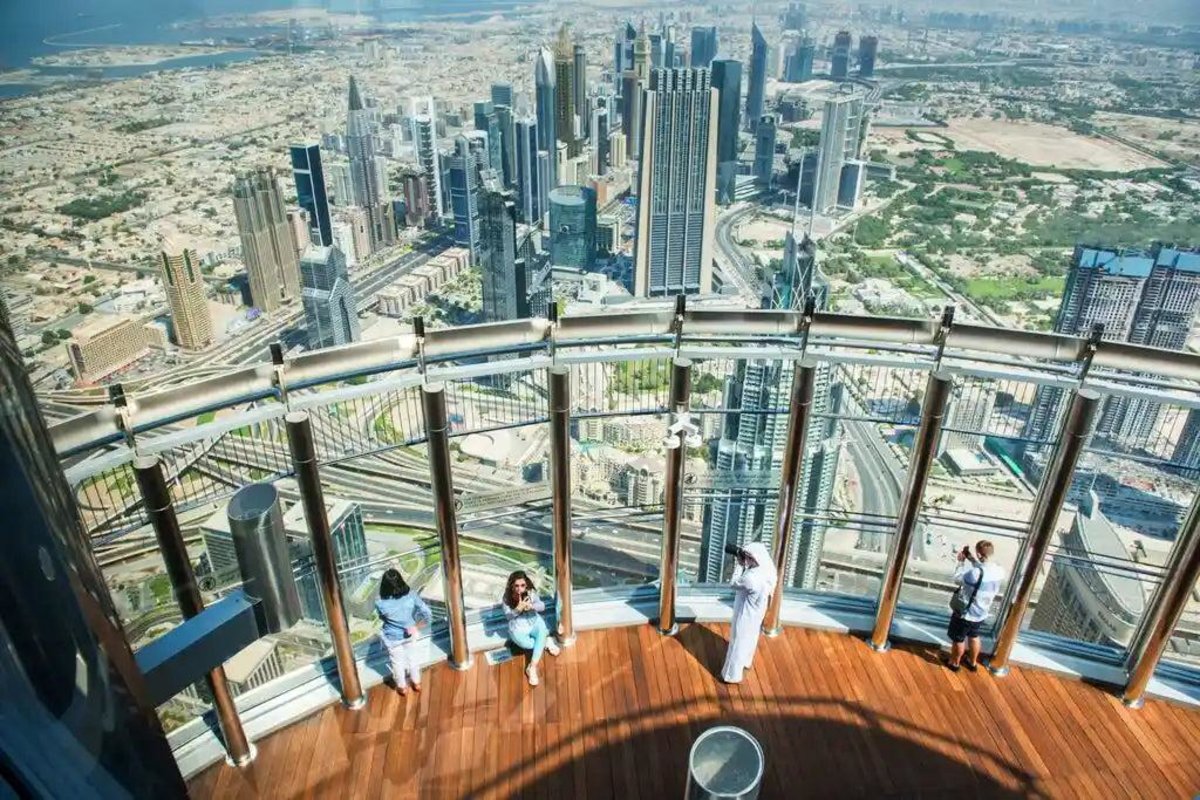
There are three main observation decks for visitors:
At the Top (Levels 124 and 125): This is the original observation deck. It has open-air terraces at 452 meters.
At the Top SKY (Level 148): This is a premium deck at 555 meters. It offers a quieter and more exclusive experience.
The Lounge (Levels 152 to 154): Sitting at 585 meters, this is the highest public lounge in the world. You can relax here with a drink and enjoy the view.
The top floors of the tower are not for people to live or work. They are used for mechanical equipment, broadcasting, and communications. Above them is the spire, which gives the Burj Khalifa its final height of 828 meters.
The Burj Khalifa is a record-breaking machine. It holds many world records. Here are the most important ones:
At 828 meters (2,716.5 feet), it is the tallest building on Earth. It broke the previous record held by Taipei 101.
A "freestanding structure" means it stands on its own without any support cables or wires. The Burj Khalifa is the tallest such structure in the world, beating the CN Tower in Toronto.
It has 163 floors that people can use. No other building has this many habitable floors.
The highest floor where people actually live or work is Level 163. That is higher than any other occupied floor in the world.
The elevators in Burj Khalifa travel 504 meters in one straight shaft. This is the longest single elevator run in any building.
The "At the Top SKY" deck on Level 148 sits at 555 meters. This is the highest outdoor observation deck in the world. (Before this, the record was held by the deck on Level 124 at 452 meters, which is also in the same building.)
The At.mosphere restaurant on Level 122 is 442 meters above the ground. It is the highest restaurant you can dine at from ground level.
The Burj Khalifa's double-decker elevators are very fast. They travel at 10 meters per second (36 km/h). But they are not the fastest in the world. The fastest elevator is in the Guangzhou CTF Finance Centre in China, which runs at 21 meters per second.
The Burj Khalifa is full of surprises. Here are 10 interesting facts that most people do not know.
The temperature at the top of the tower is about 6°C (11°F) cooler than at ground level. So, if you are on the ground floor, you might feel hot. But if you go up to the spire, you will need a jacket.
During Ramadan, people on the 80th floor and above see the sun set about 2 to 3 minutes later than people on the ground. This means they break their fast slightly later.
Dubai's air is very humid. The Burj Khalifa's air conditioning system pulls moisture from the air. This collects about 15 million gallons of water every year. This water is used to water the plants in Burj Khalifa Park.
The concrete used to build the Burj Khalifa weighs about 330,000 metric tons. That is roughly the same weight as 100,000 adult elephants.
On a clear day, you can see the top of the Burj Khalifa from up to 95 kilometers (59 miles) away. That is like standing in one city and seeing a building in another city.
The Burj Khalifa has more than 24,000 windows. A special team of cleaners uses hanging platforms to clean them. It takes them about 3 to 4 months to clean all the windows from top to bottom.
A part of the steel used in the building came from the Palace of the Republic in Berlin, Germany. That palace was demolished, and some of its steel was recycled for the Burj Khalifa.
The ground water in Dubai is salty. Salt water can rust steel. To stop this, engineers installed a system that sends a small electric current through the foundation. This blocks the salt from rusting the steel.
Rich investors from around the world own full floors in the Burj Khalifa. For example, businessman B.R. Shetty bought the entire 100th floor.
The foundation and the main concrete structure are built to last more than 100 to 150 years. So, the Burj Khalifa will stand tall for many generations to come.